




Galileo Research Facts No. 131: Can Galileo Training cause a sustainable improvement of torque at the knee?
This study documented the effects of Galileo Training and concentric, eccentric and isometric knee torque in physical active young women (25Hz, pos.3, 2*5 min., 10° flexed legs, 5/week, 3 weeks). The control group continued their usual weekly training. The Galileo group received Galileo Training only. The Galileo group showed an improvement of knee torque by up to 16%. This effects was sustained even after 3 weeks (+7%)...

Galileo Research Facts No. 127: Can Galileo Training during 55 days bedrest improve long-term bone mass at the spine?
In the 2nd Berlin Bedrest Study (BBR2) the effects of Galileo Training against the expected bone loss was tested (55 days, 24Hz, 6x1 min. exhaustive, 3/week). The control groups receive no training or identical training with-out vibration (RE). Galileo showed compared to the control groups increased trabecular bone density at the spine (L1-L3) even 2 years after the active bedrest phase with maximum improvements of up to +12%...

Galileo Research Facts No. 123: Can Galileo Training during squats increase muscle activation with each repetition?
This study investigates the effects of exhaustive squats with and without Galileo Training on muscle activation (EMG) (5*10 Sets deep squats, with & without Galileo Training, 22Hz, pos. 4, extra weight: 10RM = 60% Body mass). Compared to the control group without vibration the Galileo Group could almost triple muscle activation (+196%) during eight repetitions...
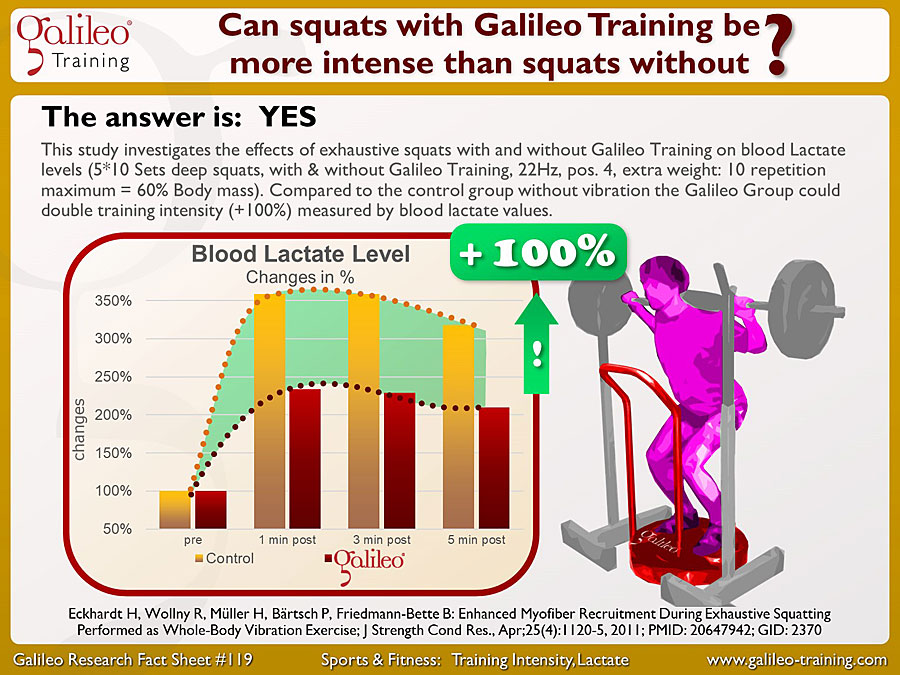
Galileo Research Facts No. 119: Can squats with Galileo Training be more intense than squats without?
This study investigates the effects of exhaustive squats with and without Galileo Training on blood Lactate levels (5*10 Sets deep squats, with & without Galileo Training, 22Hz, pos. 4, extra weight: 10 repetition maximum = 60% Body mass). Compared to the control group without vibration the Galileo Group could double training intensity (+100%) measured by blood lactate values...
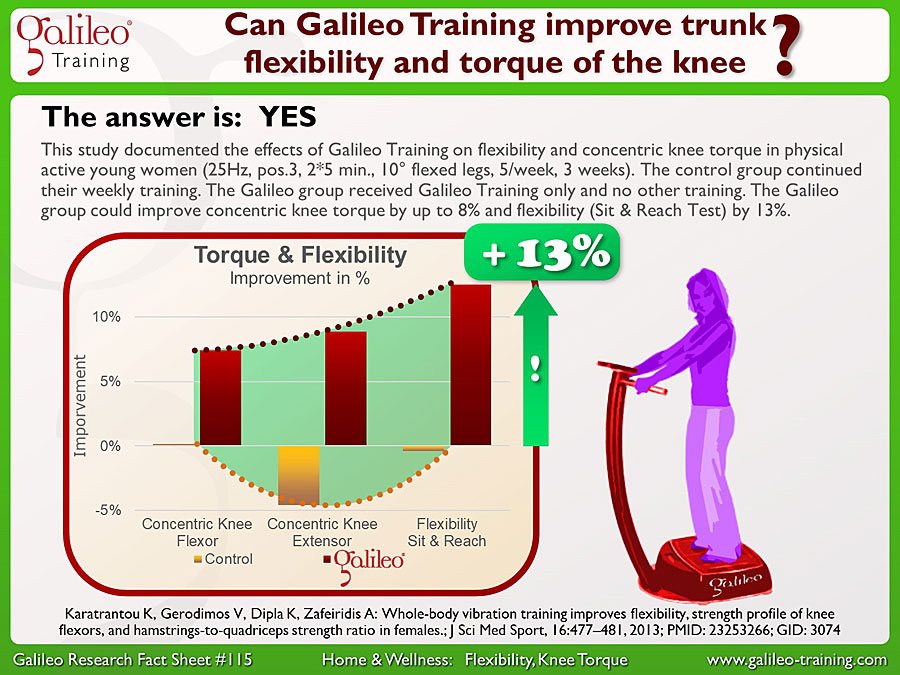
Galileo Research Facts No. 115: Can Galileo Training improve trunk flexibility and torque (force) of the knee?
This study documented the effects of Galileo Training on flexibility and concentric knee torque in physical active young women (25Hz, pos.3, 2*5 min., 10° flexed legs, 5/week, 3 weeks). The control group continued their weekly training. The Galileo group received Galileo Training only and no other training. The Galileo group could improve concentric knee torque by up to 8% and flexibility (Sit & Reach Test) by 13%...
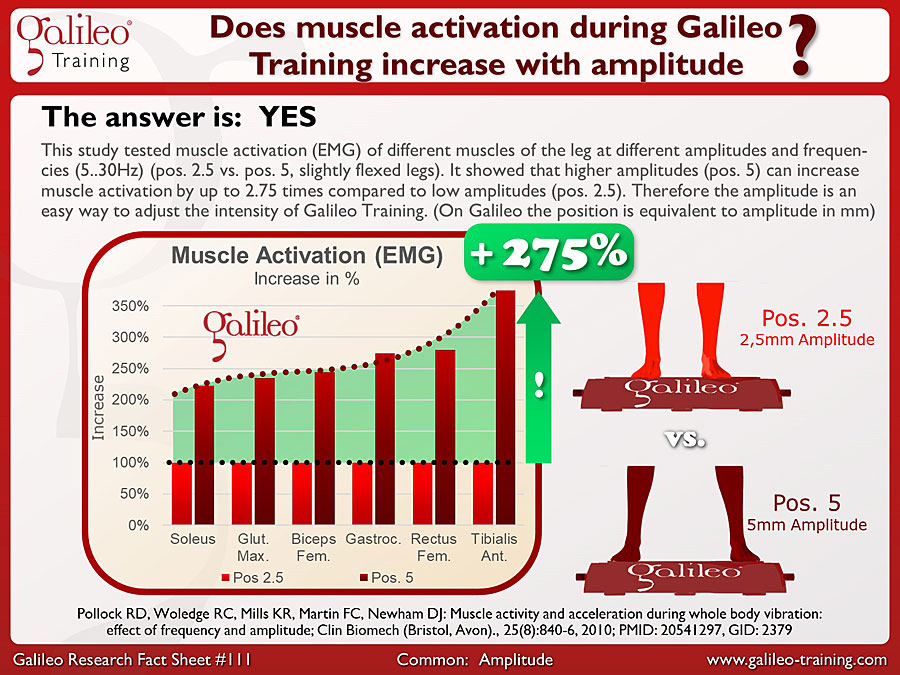
Galileo Research Facts No. 111 Does muscle activation during Galileo Training increase with amplitude?
This study tested muscle activation (EMG) of different muscles of the leg at different amplitudes and frequen-cies (5..30Hz) (pos. 2.5 vs. pos. 5, slightly flexed legs). It showed that higher amplitudes (pos. 5) can increase muscle activation by up to 2.75 times compared to low amplitudes (pos. 2.5). Therefore the amplitude is an easy way to adjust the intensity of Galileo Training. (On Galileo the position is equivalent to amplitude in mm)...

Galileo Research Facts No. 109: Can high frequencies increase muscle activation during Galileo Training?
This study tested muscle activation (EMG) of different muscles of the leg at different frequencies between 5 and 30Hz (pos. 5, slightly flexed legs). It showed that high frequencies (25-30Hz) can increase muscle activation by up to 5.5 times compared to low frequencies at 5Hz. Therefore Galileo Training targeting muscle hypertrophy and muscle power should be using high frequencies above 20 Hz to increase muscle activation...
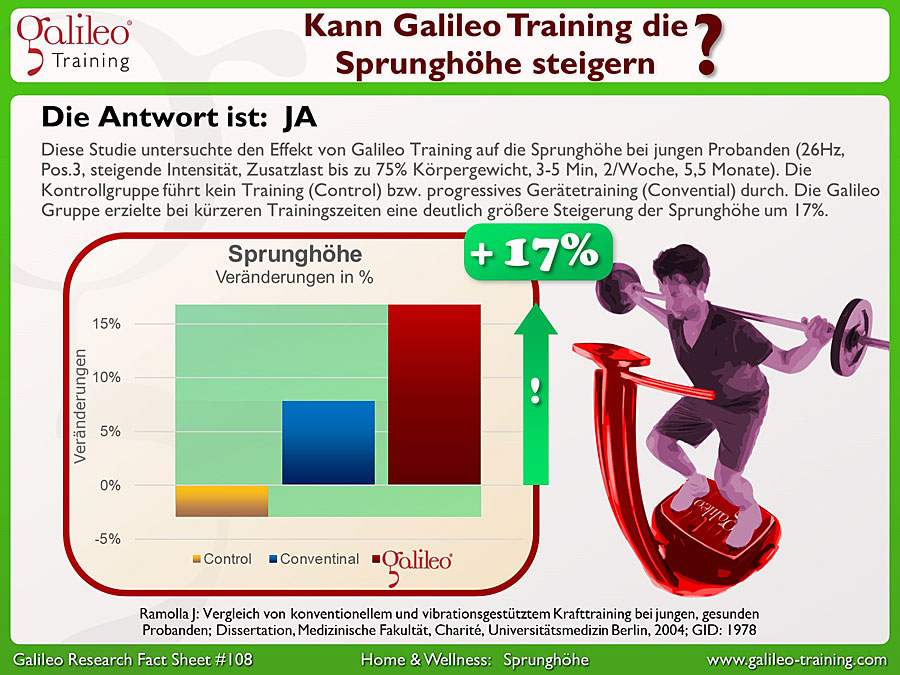
Galileo Research Facts No. 108: Can Galileo Training improve jump height?
This study documented the effects of Galileo Training on jump height in young individuals (26Hz, pos.3, increasing intensity, extra loading up to 75% body weight, 3-5 min, 2/week, 5.5 months). The control groups received no training (control) or conventional strength-training (conventional). Even though the Galileo group had the shorter training session it showed significantly higher results with up to 17% increase of jump height...
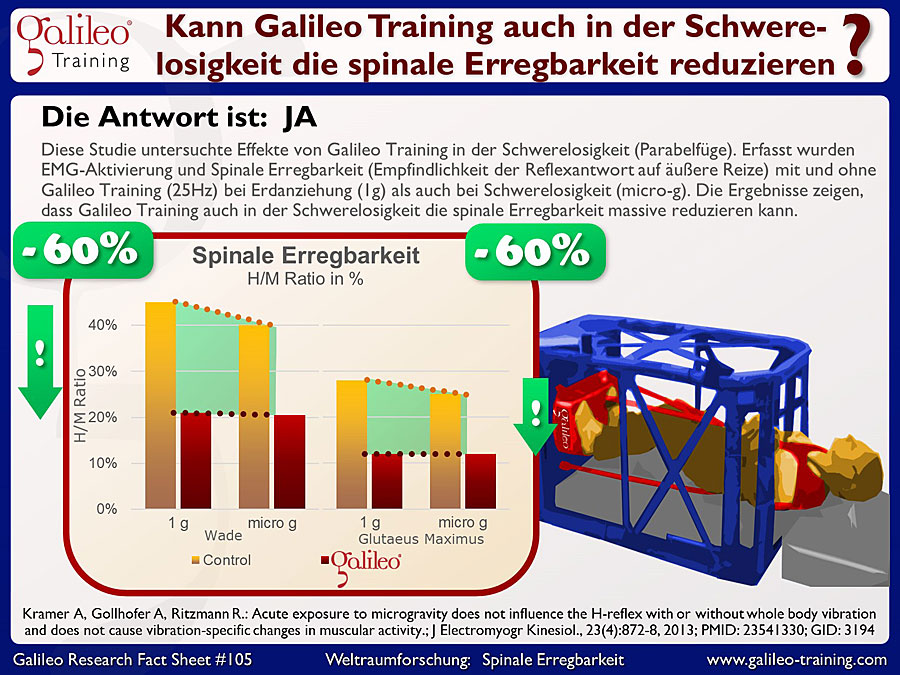
Galileo Research Facts No. 105: Can Galileo Training decrease Spinal Excitability even in micro-gravity?
This study tested the effects of Galileo Training in micro-gravity conditions (parabolic flights). The muscle activation (EMG) and the Spinal Excitability (sensitivity of reflexes reacting on an external stimulus) was assessed with and without Galileo Training (25Hz) in normal gravity (1g) and micro-gravity (micro g). The results prove that Galileo Training can significantly decrease Spinal Excitability even in micro-gravity...
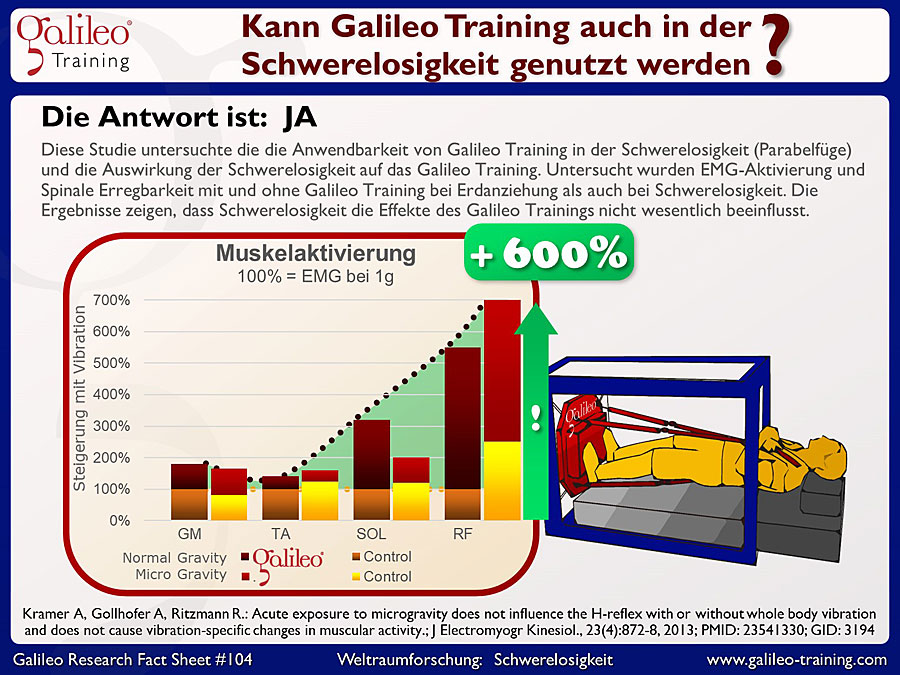
Galileo Research Facts No. 104: Can Galileo Training be used in space?
This study tested the feasibility of Galileo Training in micro-gravity conditions as well as the effects on Microgravity on Galileo Training effects. The EMG activity was assessed with and without Galileo Training in Combination with normal gravity as well as micro gravity. The results show that the effects of Galileo Training on EMG activation is not significantly altered by micro-gravity and that Galileo is feasible under micro gravity...