




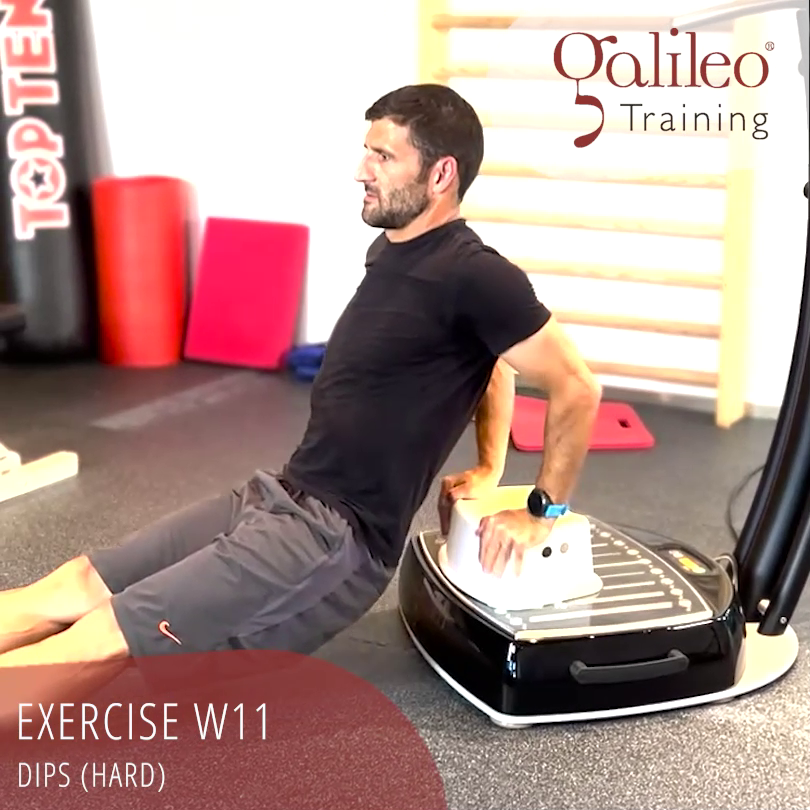
Exercise EW11: Dips (hard)
Galileo Training Exercise Video EW11 - Goal: Strengthening of Triceps, shoulder back, upper back
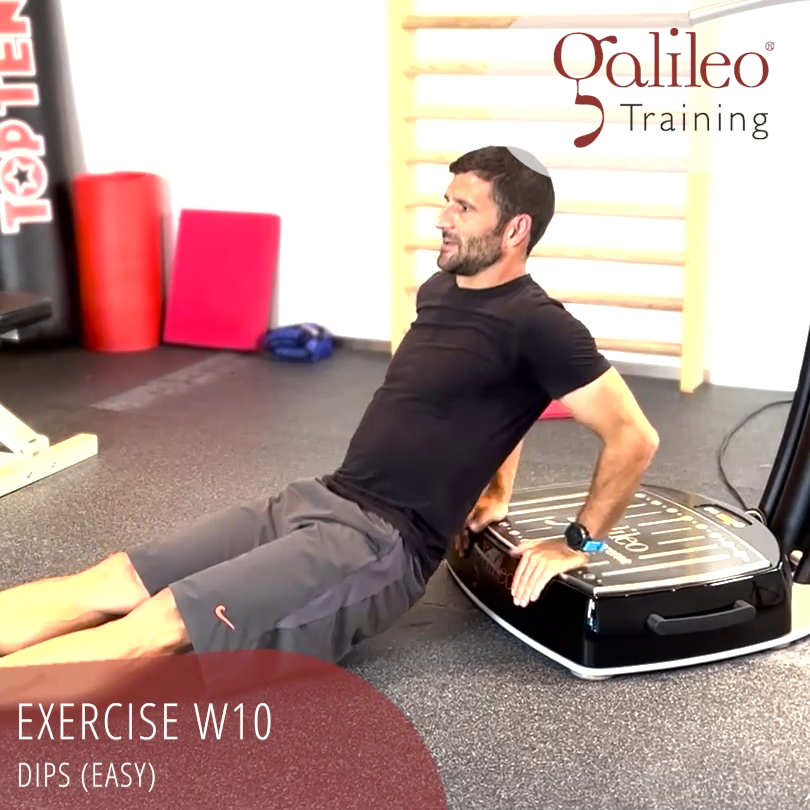
Exercise EW10: Dips (easy)
Galileo Training Exercise Video EW10 - Goal: Strengthening of Triceps, shoulder back, upper back

Exercise EW9: calf training one-legged
Galileo Training Exercise Video EW9 - Goal: Strengthening of the calf muscle – for advanced users

Exercise EW8: calf training two-legged
Galileo Training Exercise Video EW8 - Goal: Strengthening of the calf muscle – for beginners

Galileo Research Facts No. 151: Can Galileo Training make squats more efficient and more effective?
This study reported the short-term effects of Galileo Training on muscle activation and exhaustion (26Hz, 90° dynamic squats, Pos. 6, 40% body weight extra load, subjective exhaustion). The control group received identical exercises without Galileo. The Galileo groups showed higher training effects (increase lactate +205% instead of +160%) in significantly shorter time (349s instead of 515s) plus increased muscle activation...

Galileo Research Facts No. 147: Can Galileo Training compensate the effects of bedrest on the Bone Marrow Fat-Fraction?
In the 2nd Berlin Bedrest Study (BBR2) the effects of Galileo Training against the expected bone loss was tested (55 days, 24Hz, 6x1 min. exhaustive, 3/week). The control groups receive no training or identical training with-out vibration (RE). Compared to both control groups, the Galileo group showed a decrease in vertebra bone marrow fat fraction and in increase in number of red blood cells - both are related to increased endurance...

Galileo Research Facts No. 146: Can exercises with extra loads and with Galileo Training at 40Hz be more effective than without?
This study investigated the effects of squats and heel raises with extra loads on muscle function and cross-section with and without Galileo Training at 40Hz (20-40Hz, pos. 3-4, loads 80% 1RM (80kg), 3x8 squats (4 sec.), 3x12 heel raises, 6 weeks, 16 Sessions). The Galileo Group showed higher training effects with increases of isometric torque (up to +4%) and the speed indicator reactive ground contact time (-8%, Drop Jump)...

Galileo Research Facts No. 145: Can Galileo Training compensate negative vascular effects of bedrest?
In the 2nd Berlin Bedrest Study (BBR2) the effects of Galileo Training against the expected bone loss was tested (55 days, 24Hz, 6x1 min. exhaustive, 3/week). The control groups receive no training or identical training with-out vibration (RE). While the control groups showed significant decrease in vascular parameters like dilator capacity or vascular diameter, the Galileo Group could even improve some of them (Vascular Stiffness)...
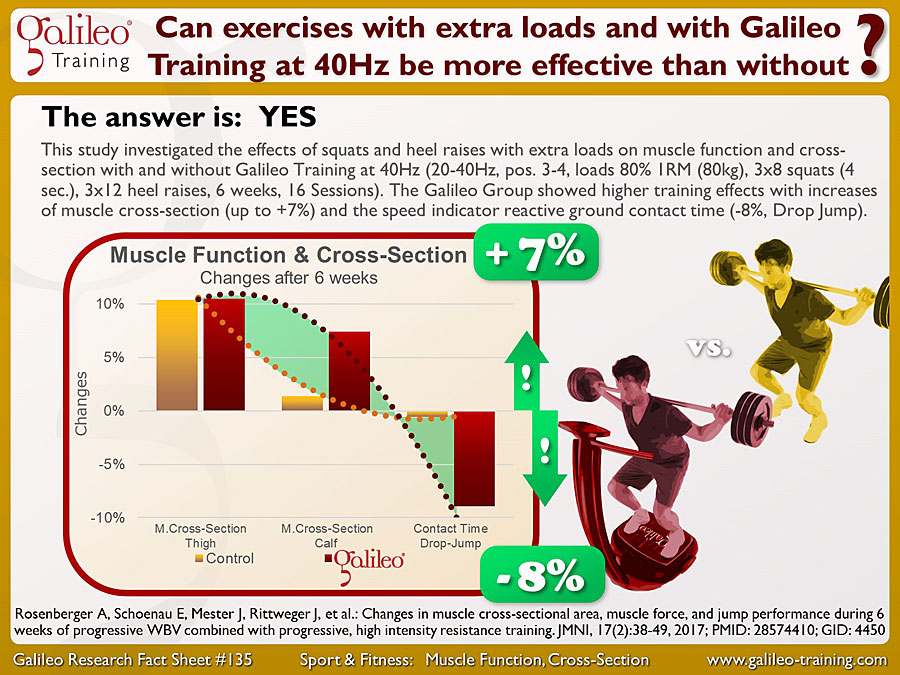
Galileo Research Facts No. 135: Can exercises with extra loads and with Galileo Training at 40Hz be more effective than without?
This study investigated the effects of squats and heel raises with extra loads on muscle function and cross-section with and without Galileo Training at 40Hz (20-40Hz, pos. 3-4, loads 80% 1RM (80kg), 3x8 squats (4 sec.), 3x12 heel raises, 6 weeks, 16 Sessions). The Galileo Group showed higher training effects with increases of muscle cross-section (up to +7%) and the speed indicator reactive ground contact time (-8%, Drop Jump)...

Galileo Research Facts No. 133: Can Galileo Training increase muscle tissue oxygenation more effectively than squatting?
This study investigated the immediate effects of Galileo Training on muscle tissue oxygenation and blood per-fusion (25Hz, 3 min., pos.2-3, 30° squats). The control group received squats (3 min, 12/min.) with additional weights matched to the VO2 values of the Galileo group. The Galileo group showed significantly higher muscle oxygenation of up to 2.4 times (+140%) starting right after the beginning and lasting longer than the exercise...