




Galileo Research Facts No. 144: Can 3 weeks of Galileo Therapy improve balance in COPD patients?
This study documented the effects of Galileo Therapy on Balance and muscle function in COPD patients. Both groups received endurance training (15 min.) + strength training (50 Min) 5/week, as well as additional 4*2 min. squatting exercises with or without Galileo (24-26Hz, pos. 2.5, 3/week, 3 weeks). The Galileo group showed significantly higher effects on Balance with improvements of up to 28% (e.g. semi-tandem stance, eyes closed)...

Galileo Research Facts No. 124: Can Galileo Therapy improve muscle force and endurance in COPD-patients?
This study investigated the effects of Galileo Therapy in COPD patients. (6-24Hz, 3*3 min., progressive, 150° squat, pos.2-3, 2/week, 3 months, +15 min. warmup+cool-down). The control group received Calisthenics exercises (2*30 min./week). While the control group did not show any significant changes that Galileo group showed highly significant improvements in muscle force and endurance with up to +38% (leg press, 1RM)...

Galileo Research Facts No. 121: Can Galileo Training increase muscle function and balance at the same time?
This study investigated the effects of Galileo Training on muscle function an balance in women age 52 to 60 (15-25Hz, 6 exercises, extra loads up to 30% body weight, pos.1-3, 35 min., 3/week, 12 weeks). The conventional group received identical exercises without vibration. The Galileo group showed identical results on muscle function but significantly higher results on all tested balance test with improvements o up to 61%...

Galileo Research Facts No. 120: Can Galileo Therapy increase muscle and lung function in Cystic Fibrosis patients?
This study investigated the effects of Galileo Therapy on lung and muscle function of adult Cystic Fibrosis patients (age 24-47, 20-25Hz, pos. 1, 10*3 min./week, 3 months). The results showed that Galileo Therapy could significantly improve lung function (+5%) and muscle function e.g. in the chair rising test (CRT) in muscle power (+16%) and muscle force (+34%)...
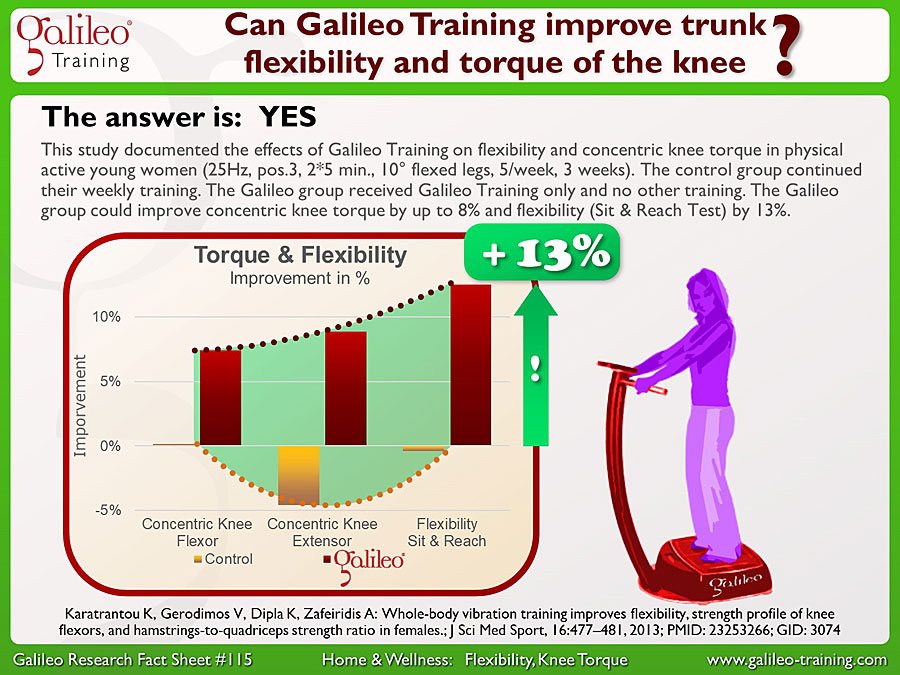
Galileo Research Facts No. 115: Can Galileo Training improve trunk flexibility and torque (force) of the knee?
This study documented the effects of Galileo Training on flexibility and concentric knee torque in physical active young women (25Hz, pos.3, 2*5 min., 10° flexed legs, 5/week, 3 weeks). The control group continued their weekly training. The Galileo group received Galileo Training only and no other training. The Galileo group could improve concentric knee torque by up to 8% and flexibility (Sit & Reach Test) by 13%...

Galileo Research Facts No. 94: Can Galileo Therapy improve the disability status of MS patients?
This study investigated the effects of 8 weeks of Galileo Therapy on different disease related scores (PDDS, MSCF) in MS (Multiple Sclerosis) patients (20Hz, pos. 1.5, 5*1 min., 3/week, 8 weeks, 20° bent legs). The results show not only improvements in PDDS and PSAT-3 by up to 18% but also an increase in HSFC (MS Functional Composite: walking distance, hand function, calculation test) in average by 0.36SD...

Galileo Research Facts No. 93: Can 5*10 min./week Galileo Training prevent loss of muscle function during 55 days bedrest?
During the 1st Berlin Bedrest Study (BBR) individuals had to stay in bed for 55 days completely. The control group did no training at all, the Galileo group received 10 Min., 5 days/week 12-26Hz of intense Galileo Training while in bed. The Galileo group could prevent loss of muscle function almost completely while the control group lost muscle function by up to 28%...

Galileo Research Facts No. 88: Can Galileo Therapy improve balance and muscle function in Parkinson’s patients?
This study documented the effects of Galileo Therapy on muscle function and balance in Parkinson’s patients (25 Hz, pos. 3-5, 2x15 min/day, 3 weeks). Both groups received 40 min. 5/week physio therapy (relaxation, stretching, body perception), one group received additional Galileo Therapy. The Galileo group showed significant improvements in 10 min. gait distance and massive improvements in balance up to 33%...
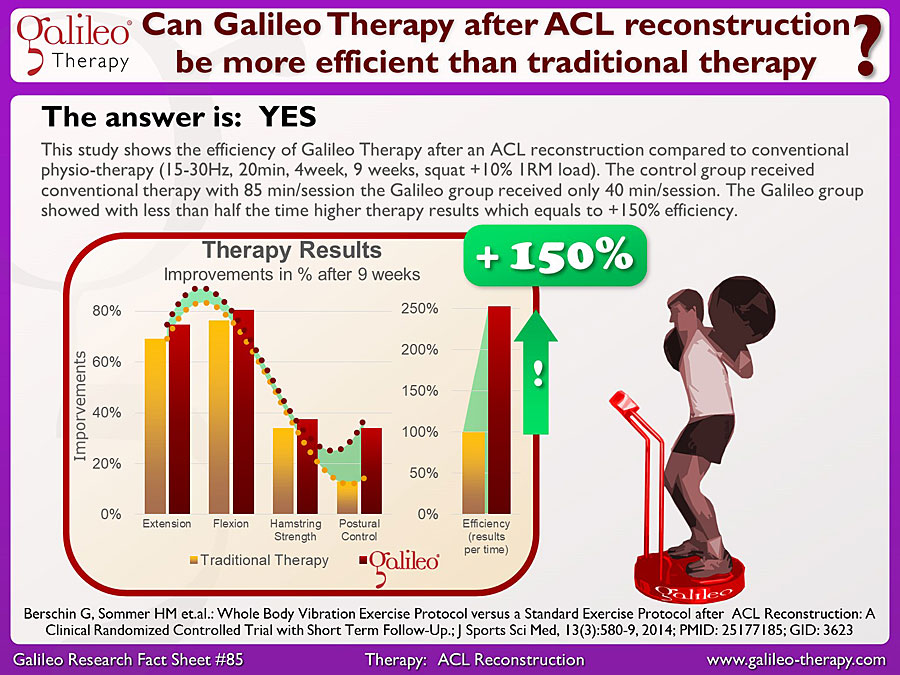
Galileo Research Facts No. 85: Can Galileo Therapy after ACL reconstruction be more efficient than traditional therapy?
This study shows the efficiency of Galileo Therapy after an ACL reconstruction compared to conventional physio-therapy (15-30Hz, 20min, 4week, 9 weeks, squat +10% 1RM load). The control group received conventional therapy with 85 min/session the Galileo group received only 40 min/session. The Galileo group showed with less than half the time higher therapy results which equals to +150% efficiency...
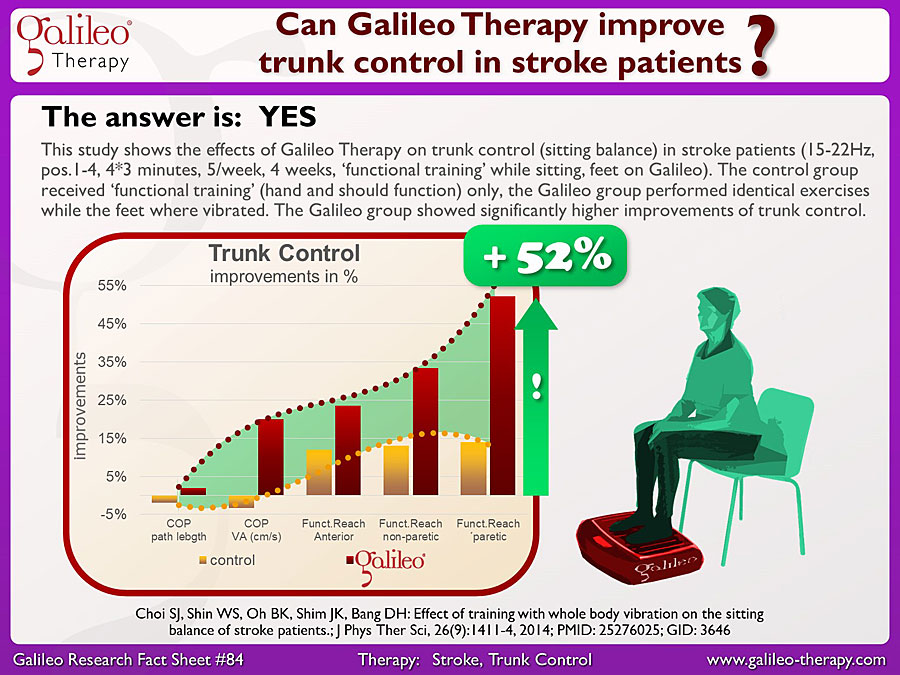
Galileo Research Facts No. 84: Can Galileo Therapy improve trunk control in stroke patients?
This study shows the effects of Galileo Therapy on trunk control (sitting balance) in stroke patients (15-22Hz, pos.1-4, 4*3 minutes, 5/week, 4 weeks, ‘functional training’ while sitting, feet on Galileo). The control group received ‘functional training’ (hand and should function) only, the Galileo group performed identical exercises while the feet where vibrated. The Galileo group showed significantly higher improvements of trunk control...