




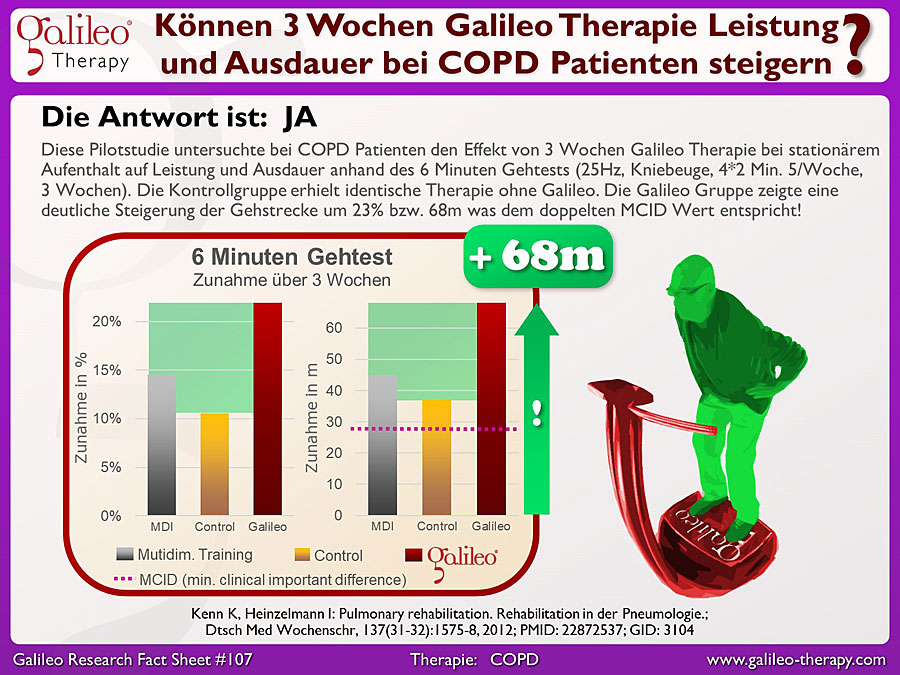
Galileo Research Facts No. 107: Can 3 weeks of Galileo Therapy improve power and endurance in COPD patients?
This pilot study examined the effects of 3 weeks of Galileo Therapy on muscle power and endurance measured by 6 minutes walk test in COPD in-patients. (25Hz, squat, 4*2 min. 5/week, 3 weeks). The control group received identical therapy without Galileo. The Galileo group showed a highly significant improvement in the walking distance by 23% or 68m which is equivalent to over two times the MCID...
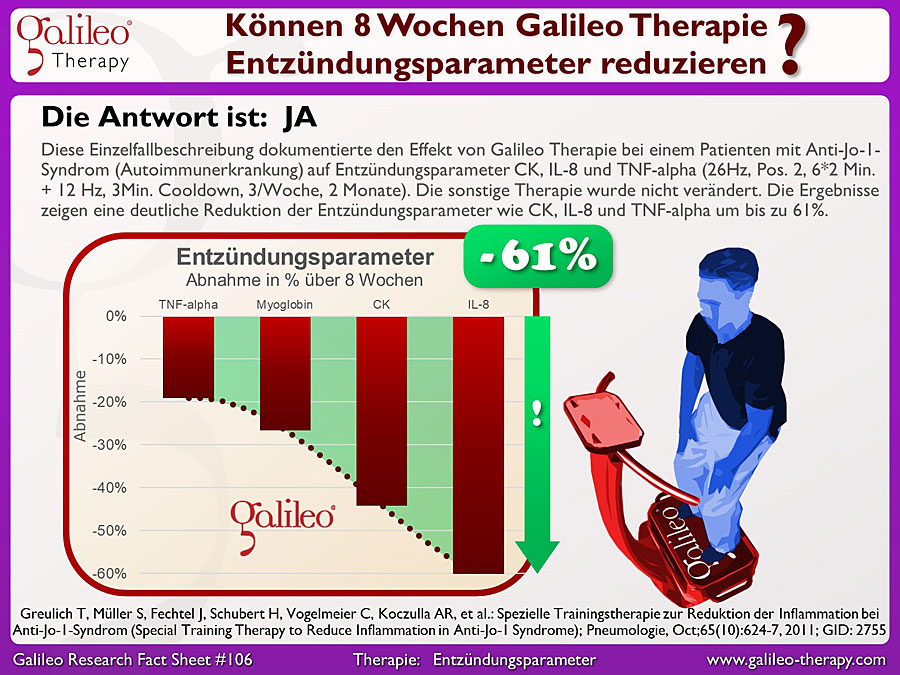
Galileo Research Facts No. 106: Can 8 weeks of Galileo Therapy decrease inflammation markers?
This case study reported the results of Galileo Therapy in a patient with Anti-Jo-1-Syndrome (auto-immune disease) on inflammation markers like CK, IL-8 and TNF-alpha (26Hz, pos. 2, 6*2 min. + 12 Hz, 3min. cool-down, week, 2 months). Additional therapy was not changed during this time. The results show a significant decrease of the inflammation makers CK, IL-8 and TNF-alpha after 8 weeks by up to 61%...

Galileo Research Facts No. 103: Can Galileo Therapy improve muscle mass and bone mass in OI patients?
This study documented the effects of Galileo Training in children with OI (Osteogenesis Imperfecta) during the Cologne therapy concept “auf die Beine” on muscle and bone mass (10-20Hz, patient individual exercises, 10*15min./week, 6 months + 6 months follow-up). The results show a growth effect corrected significant increase in muscle mass (legs up to 14%) and bone mass (leg up to 31%)...
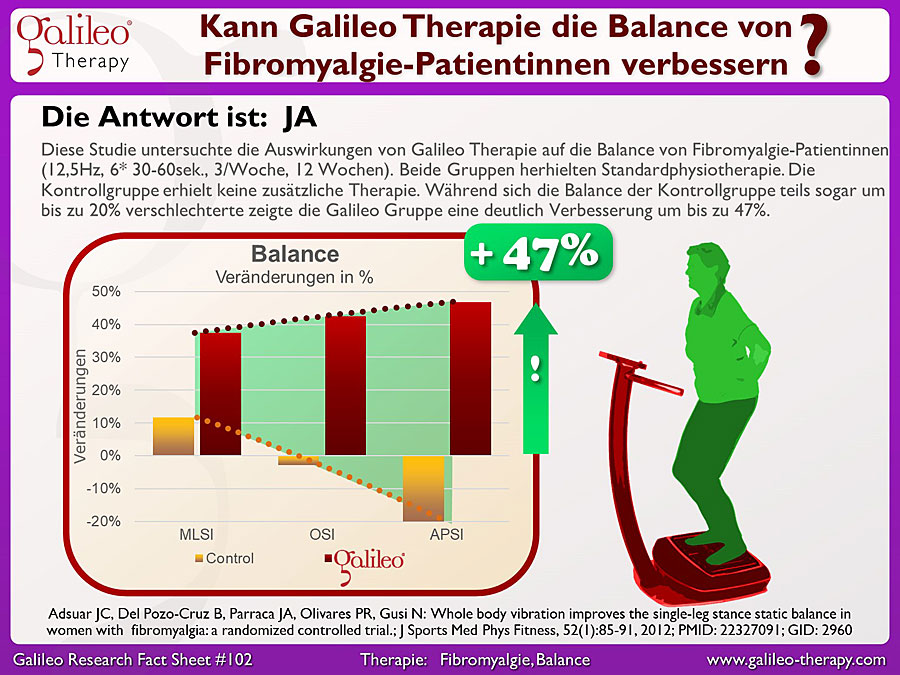
Galileo Research Facts No. 102: Can Galileo Therapy improve balance in Fibromyalgia patients?
This study investigates the effects of Galileo Therapy on balance in Fibromyalgia patients (12,5Hz, 6* 30-60sec., 3/week, 12 weeks). Both groups received standard physiotherapy. The control group received no additional therapy. While the control group decreased in many tested parameters of balance ability by up to 20% the Galileo Therapy group improved by up to 47%...

Galileo Research Facts No. 98: Can Galileo Therapy at work decrease subjective back pain?
This study documented the effects of workplace-based Galileo Therapy on subjective back pain in individuals with chronic lower-back pain (10-30Hz, slightly bent legs, pos. 1-3, 15 min., 2-3/weeks, 3 months). The control group received no therapy. While the control group slightly decreased the Galileo Therapy group improved by up to 4.5% and showed a tendency to decrease days of sick-leave per month...

Galileo Research Facts No. 94: Can Galileo Therapy improve the disability status of MS patients?
This study investigated the effects of 8 weeks of Galileo Therapy on different disease related scores (PDDS, MSCF) in MS (Multiple Sclerosis) patients (20Hz, pos. 1.5, 5*1 min., 3/week, 8 weeks, 20° bent legs). The results show not only improvements in PDDS and PSAT-3 by up to 18% but also an increase in HSFC (MS Functional Composite: walking distance, hand function, calculation test) in average by 0.36SD...

Galileo Research Facts No. 91: Can Galileo Therapy decrease Creatine Kinase levels in Duchenne (DMD) patients?
This study shows the effect of Galileo Therapy on Creatine Kinase (CK) levels in Duchenne Patients (5-20Hz, 2*1 to 2*2 min., 3/week, 12 weeks). Over a period of 3 months the CK levels dropped essentially by 98% and increases again after the end of the therapy period. CK is believed to indicate the amount of muscle fiber damage due to extensive muscle activity and therefore should be kept low in Duchenne patients...

Galileo Research Facts No. 89: Can 3 minutes Galileo Therapy improve balance in unilateral chronic stroke patients?
This study documented the acute effects of 4*45 seconds of high-frequency Galileo Therapy on balance in unilateral chronic stroke patients (30Hz, 4*45 sec., pos. 3, slight squat). The results show that Galileo Therapy in chronic stroke patients can improve balance in just 3 minutes by up to 13%...

Galileo Research Facts No. 88: Can Galileo Therapy improve balance and muscle function in Parkinson’s patients?
This study documented the effects of Galileo Therapy on muscle function and balance in Parkinson’s patients (25 Hz, pos. 3-5, 2x15 min/day, 3 weeks). Both groups received 40 min. 5/week physio therapy (relaxation, stretching, body perception), one group received additional Galileo Therapy. The Galileo group showed significant improvements in 10 min. gait distance and massive improvements in balance up to 33%...
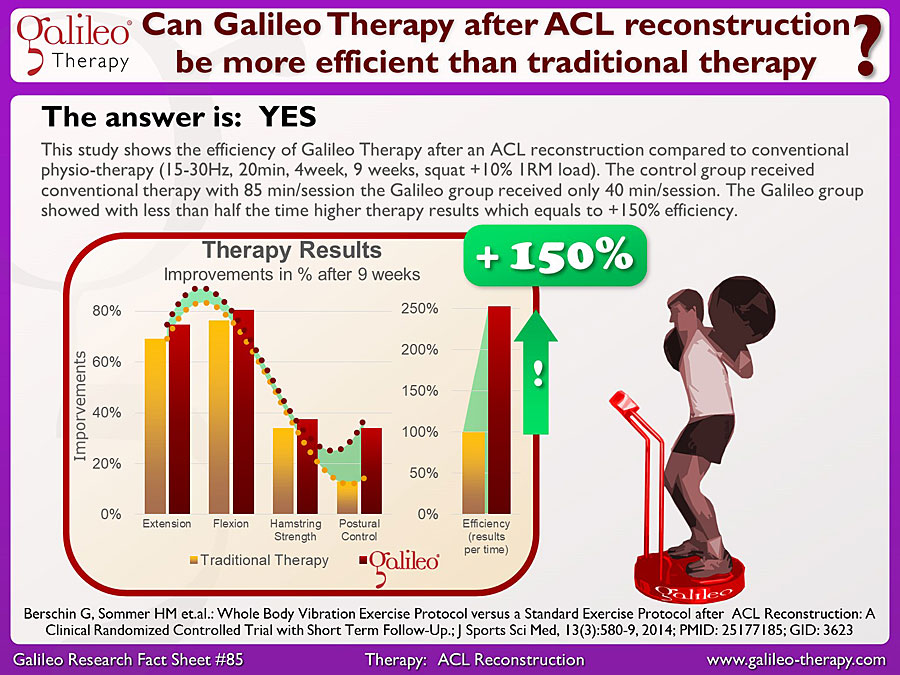
Galileo Research Facts No. 85: Can Galileo Therapy after ACL reconstruction be more efficient than traditional therapy?
This study shows the efficiency of Galileo Therapy after an ACL reconstruction compared to conventional physio-therapy (15-30Hz, 20min, 4week, 9 weeks, squat +10% 1RM load). The control group received conventional therapy with 85 min/session the Galileo group received only 40 min/session. The Galileo group showed with less than half the time higher therapy results which equals to +150% efficiency...